Why Cardiac Ultrasound Matters in Small Animal Practice
2026-03-04
In everyday practice, cardiac cases rarely arrive with clear answers.
A mild murmur during a routine check.
A dog that gets tired more easily than before.
A cat that seems normal — until it isn’t.
These are familiar moments. And more often than not, they lead us to one tool: ultrasound.
Over time, we’ve worked with veterinarians across different clinics and regions, and one thing has become increasingly clear. Cardiac ultrasound is one of the most powerful tools in small animal practice — but also one of the hardest to truly master.
Not because the technology is difficult to access, but because consistency is difficult to achieve.
Different operators. Different habits. Different levels of experience.
And sometimes, even when the scan is performed correctly, the results may still vary slightly from one examination to another.
This isn’t a limitation of ultrasound. And it’s certainly not a limitation of clinicians. In fact, it reflects just how much cardiac imaging depends on experience.
But it also leads to an important question — one that sits at the center of this series:
“Can cardiac ultrasound become more consistent, without losing the value of experience?”
This is why we are starting this series.
1. Understanding What We Are Actually Looking At
Before talking about probe position or standard views, it helps to step back and ask a simple question:
What are we really evaluating during a cardiac scan?
At its core, echocardiography focuses on two things:
Structure and function.
Structure —
the size of the chambers, the thickness of the walls, the overall geometry of the heart.
Function —
how effectively the heart pumps, how valves move, and how blood flows through the chambers.
What makes ultrasound unique is that both can be assessed in real time.
“Echocardiography is widely regarded as the most informative non-invasive method for assessing cardiac morphology and function in small animals.”
But being able to “see” the heart is only part of the process.
How we obtain that image determines how reliable it is.
2. A Practical Starting Point Getting a Usable Cardiac View
Before we go deeper into standard views, there is one practical question worth answering:
What does a “usable” cardiac image actually require?
In clinical practice, a good starting point often comes down to three simple elements:
1. Stable patient positioning
Most small animal cardiac scans are performed in lateral recumbency. Stability matters — even small movements can affect image quality and measurement accuracy.

2. Consistent probe orientation
The probe marker must align with the standard reference direction for each view. Without consistent orientation, images become difficult to interpret and compare.

3. Recognizable anatomical landmarks
A usable view is not just “a heart on the screen.”
Key structures — chambers, valves, septa — should be clearly identifiable.
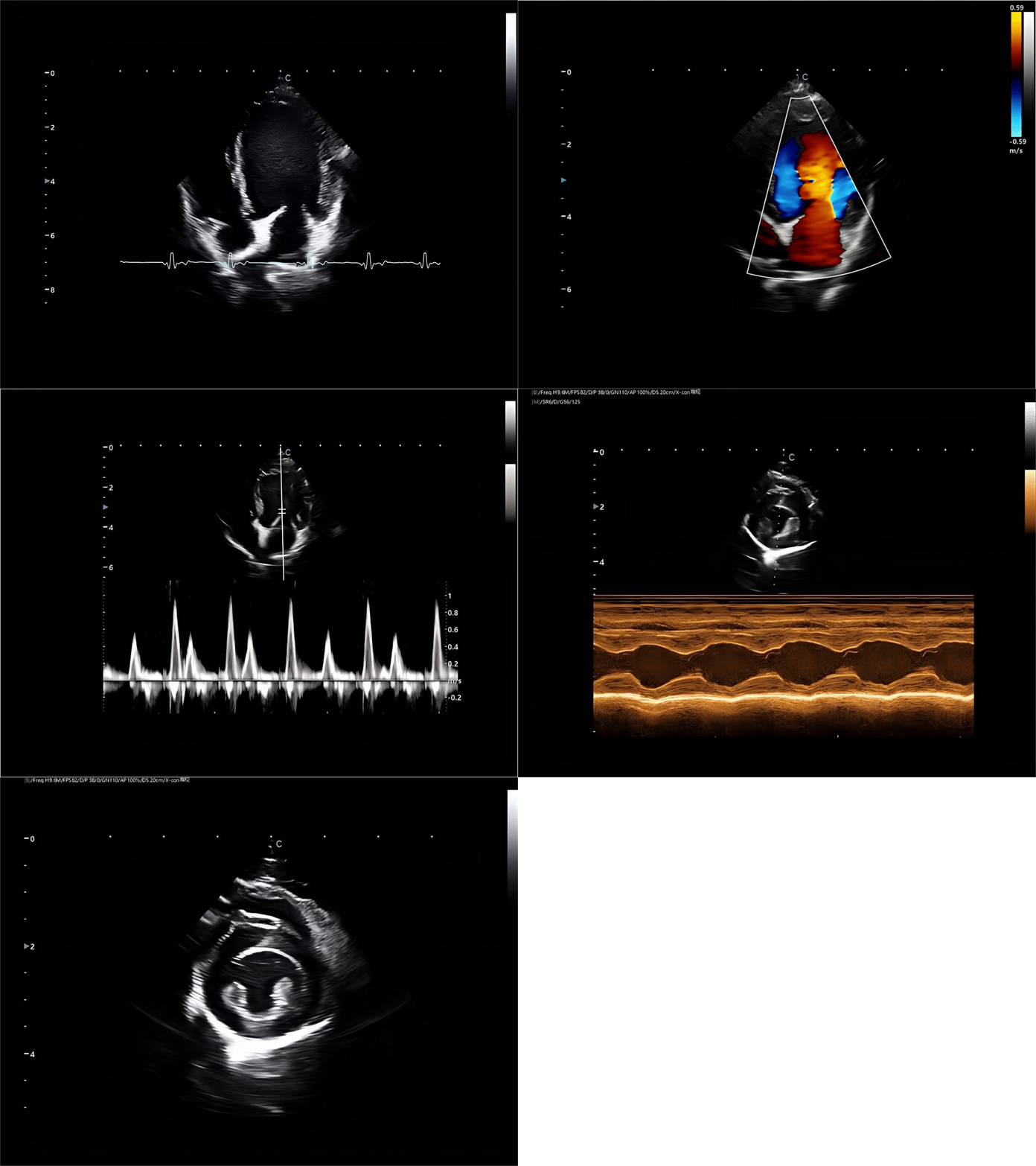
“Accurate echocardiographic assessment depends on proper patient positioning, probe alignment, and identification of standard anatomical landmarks.”
These may seem like small details.
But in reality, they determine whether a scan is repeatable, comparable, and clinically meaningful.
3. Why This Matters More Than It Seems
Standard views are often introduced as technical requirements.
In practice, they are something more fundamental:
They are what make cardiac ultrasound consistent.
When images are obtained from comparable planes:
Measurements become more reliable Follow-up exams become meaningful Different clinicians can interpret findings with greater alignment “Variability in image acquisition can affect measurement reproducibility in echocardiography.”
And this is where many of the challenges in cardiac ultrasound begin. If consistency is the goal, then the next step becomes clear: How do we obtain these views reliably, in everyday clinical conditions?
That is where we will go next.
In the following article, we’ll focus on the foundations of every cardiac scan.
And from there, we will move further — into measurements, Doppler interpretation, and eventually, a more structured way of cardiac assessment.
Because before we talk about numbers,
we need to make sure we are all looking at the same heart, in the same way.
References
[1] Thomas, W. P., et al.
Diagnostic Atlas of Canine and Feline Echocardiography. Elsevier.